By Sarah Kuchar, owner of Kuchar Studio
Older homes come with quirks, but they also offer details that are rarely built today. The challenge of a vintage renovation is not choosing between old and new. It is deciding what to preserve, what to open up, and where a modern hand makes the space work for the way people actually live. Mixing old and new is one of my favourite styles to design, and a recent Chicago renovation is a good study in how to do it successfully.
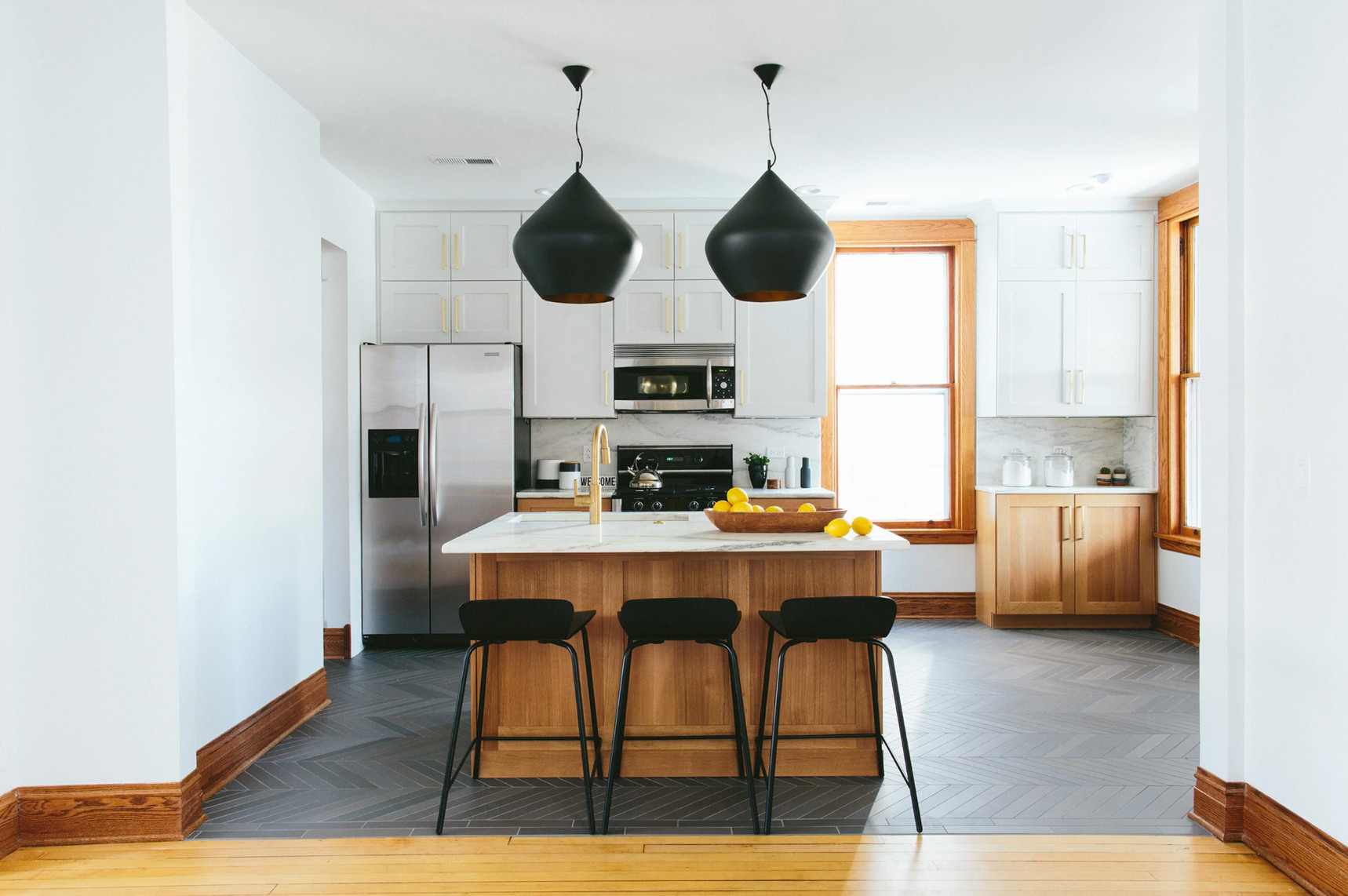
It is common in older homes to have a great deal of separation between rooms. I love that quality in vintage design, but in this house the kitchen was closed off to the point of feeling dark and dated. Rather than gut the home’s character, we opened the walls to the dining room and reintroduced light through lighter finishes and better fixtures.
Material choices did most of the work. We replaced the original orange flooring with a chevron tile made in Italy, chosen for the colour variation within each tile, which gives it a handmade look suited to a vintage home. Lighter cabinets, marble counters, and modern brass pulls brightened what had been a dim room while keeping a sense of period charm.
For the stone, we used a white marble quarried in Vermont. It is typically less porous than Italian marble, so it resists staining, and it is less expensive while remaining just as beautiful. We ran the same slab up as the backsplash; that monolithic installation reads as far more modern than mosaic tile. Against the white backdrop, we hung oversized pendants lined in hammered copper that glow when lit, balanced by a lighter-scale black stool. The final mix of brass, white marble, and black metal carries into the dining room, where many original details were left intact, including a brass pendant from the previous owner that we kept.
Vintage homes also tend to lack bathrooms by current standards. This one had no primary bath and little room to add one. When the homeowner suggested converting a small closet, I was sceptical, but with careful planning and a sliding barn door, it worked. We reduced the counter depth beside the sink to fit the toilet while keeping drawers and storage, then centered the sink as the deepest point, with the toilet to one side and the shower to the other. It is efficient, and it works.
That is the heart of a successful vintage renovation: honour the history, solve for today, and let the original details lead.
For more information visit: https://www.kucharstudio.com/